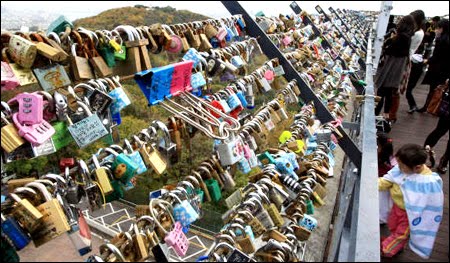
The must-go highlight of the Korea trip were 2 places.
1) The "expensive" but worthwhile DMZ Tour - Demilitarized zone Tours - which is one of the last relics of the Cold War.
2) The Le-Petit Prince Village
It divides the North Korea from South Korea.
To go for this tour, it is a must to go along with the travel agencies and one must bring one's passport for verification. In addition, it is mentioned that you are not allowed to wear certain colors else you will get shot by the North Korean military soldiers. And that you are not suppose to take out or show your camera unless there is given permission to, otherwise you might get caught and thrown in jail or get shot at as being a spy. Also you are not allowed to point or stare at any North Korean solders or persons standing on North Korea soil. The introduction to the tour was as such and before going, this set of strict instructions created an imagery of suppression in my mind.

Prior to this I had a certain understanding of North Korea that always perturbed my mind.
1. North Korea is lead by a dictator, Kim Jong II. I Watched a documentary of the North Korean life where they all dedicate their life to the motto and image of the North Korean leader Kim Jong II as they believe it is he who has given them the hope to life. Was it a "brainwashed" regime or a " fearful" regime that has been so give no choice.
2. North Korea people are starved. And in recent times because of the war ship crash, aid is being prevented from reaching North Korea , many more North Koreans are starving to death.
3. And those who do not conform and try to escape, are shot or tortured. Watched a move about the North Korean trying to go to China to earn some extra cash for their sickly or their family, and them having to trudge through the river, when caught, their whole family is sent to concentration camp and are worked to their death or are shot.
4. Many North Koreans are separated from their love ones who managed to escape to South Korea. And at any point of one year, North Korea and South Korea opens their gates to allow some of the North Korean visit their relatives. Its such a heart-rendering scene.
A heavy heart accompanied me as I embarked on this tour.
There are a number of agencies such as USO((02) 795-3028),Korean Travel Bureau Panmunjom Travel Center ((02) 778-0150/(02) 771-5593), Chung Ang Express Tour ((02) 2266-3350) and the International Cultueral Service Club ((02) 399-2700). I went with the USO because it was recommended by my friend. The cost is quite pricely and you can op to pay it in USD if you have insufficient won left. The thing about the tour is that you need to shuffle from one place to the other without insufficient time for you to really appreciate what you have seen and witness. Thats a regret about tours.

For the USO Tour, one meets at the Lotte Hotel where they have a office that has personnels that can speak multiple languages. One must do reservation before hand via email before you turn up, else you might be turned away if the tour is already full. The Journey to DMZ takes around 2 hours and we were stopped and a army personnel came up to check our passports. (Republic of Korea and United States Forces Korea soldiers (known as "security escorts") conduct the United Nations Commander DMZ Orientation Program tours of the JSA and surrounding areas. )We were then told to change from our USO Bus to the Republic of Korea army's secure bus. Our tour guide then begin telling us the story of our location, the camp bonifas.

Camp Bonifas is a United Nations Command military post located 400 meters from the southern boundary of the Korean Demilitarized Zone. It is 2400 meters from the military demarcation line and lies within the Joint Security Area (JSA), also known as Panmunjom. The Military Demarcation Line (or 38th Parallel) forms the border between South Korea (the Republic of Korea) and North Korea (the Democratic People's Republic of Korea).
Camp Bonifas is home to the United Nations Command Security Battalion - Joint Security Area, whose primary mission is to monitor and enforce the Armistice agreement of 1953 between North and South Korea.
The camp, formerly known as Camp Kitty Hawk and Camp Liberty Bell, was re-named on August 18, 1986, in honor of U.S. Army Captain Arthur G. Bonifas (posthumously promoted to major), who along with 1LT Mark T. Barrett, were killed by North Korean soldiers in the "Axe Murder Incident" - which was an incident where North Koreans have axed and killed US Soldiers because of the pruning of a tree (where according to them were not allowed since their leader did not give approval) .
(Wikipedia)

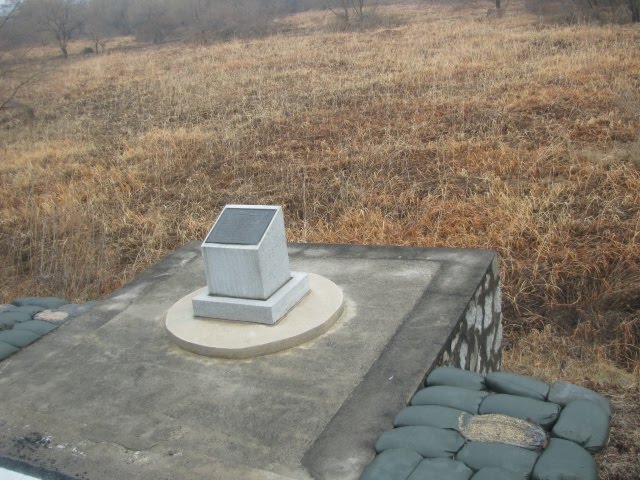
Next, we moved on to a railway track where they descibed it to be Dorasen Station. It is 700 metres away from the southern part of DMZ. It was a railway track that once connected South Korea and North Korea. According to sources, In Dec 2008, the North Korean government closed the track because of some confrontational policy. The wonder of this track is that it is shown that there are plans to further the lines to europe and China in the future. Imagine if that happens!

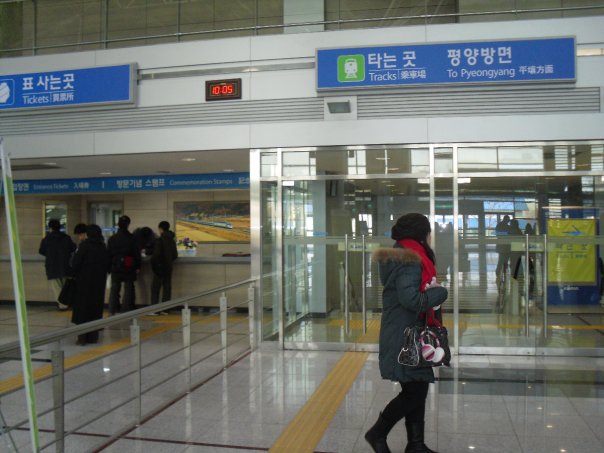


And then next our bus made a move to a building that was explained as a location for the reunification meetings of the South koreas and North Koreans- the Dora Observatory.

In it, there was a model of the DMZ Zone and how it was segregated. Outside there were telescope that allowed you to view the zone and we were trying to spot some North Koreans

- and we did see a village. It was then explained to us that it was the Gijeong Dong propaganda village - it was built in the northern area of DMZ for the purpose of propaganda . The village has no residents except soldiers. The world tallest flag stands at its entrance.

Nearby it also has the Daeseong Dong freedom village - about 200++ resident farmers live there and they were those that families who stayed there before the Korean war. The residents there recieves preferential treatment such as exemption from military service but they must strictly follow the midnight curfew and strict rules. Beyond that were mostly forests and thats where all the North koreans who want to come over South Korean have to trudge through. And most of the time, before they reach the base, they get tracked down and shot to death.

Beside the telescope was a yelow-lined box that had the word photo line on it, You must stand inside the yellow line to take a picture. Asked the guard about it and he said it was a rule.

Located near the Dora observatory museum, was the 3rd Infiltration Tunnel.

It was dug up by the North Koreans to faciliate an invasion into South Korea. It was said that it was discovered by a North Korean Defector. We made our way down to the tunnel via a tram

then walking through the 265 metres tunnel with a helmet and a hunched back.If you are tall or is claustrophobic, this might not be something you want to try. After listening to the history of the tunnel, we were given the choice to either walk up or sit the tram. I walked and it was a really tiring walk. In the tunnel, with a lack of air and space, it was also very steep and I could hear my heart beating in the head. A very good exercise indeed.
Then at the same place, we were given a walkthrough of the history of DMZ - they had the models and write-ups.


It was then lunch time. So they brought us to a restaurant to eat. It was fantastic. I loved it. Yummy!


Following that, we went up the bus that took an upslope route to the next destination - the Odusan unification Observatory. This 5 story observatory is located just 460 metres away from North Korea.


They held the hopes of South Koreans whose relatives were still in North Korea - with heart-rendering messages and photos of their loved ones.


From the top through the telescope, it captured what I felt. A hope that lights dimly.


And we left our own message to the families " Keep your hopes alive"


The last stop was Panmunjeon /Joint Security Area (JSA) which was the highlight of the trip.We were instructed not to show our cameras until told and then lined up like small children going on excursion.

We were also instructed not to look at the guards eyes directly else risk being termed as a spy and shot. The tension inside the building was heightened by the guards dressing - with the white gloves, the black sunglasses and their stern expressions.


Our tour ended with the last stop being a sovenier shop for us to North Korean stamps , currency and more.

All in all, for the DMZ Tour, I think the timing that you choose to go is very important. For mine, because of some political tension that happened at that moment of time, the tour to the room between North Korea and South Korea discussion was shut away from the public and we were not even allowed to stand on the steps to see the guards. But overall, would say it has been a meaningful trip though some might say a really touristy trip.
For the Le Petit France Village

This is a village that translates the story into real life figurines and atmosphere. Loved it. The entire village is set to the concept of ‘Little Prince,’ and according to the founding President Han Hong-seop, ‘Flower, stars and the Little Prince’ is Petit France’s catch phrase. Petit France has made a formal license contract with the Saint Exupery Foundation at Lyonnais, France, a foundation of the author of
‘Petit’ means ‘small and pretty’ in French, and this village is located on the hilltop overlooking the beautiful mountain scenery of Homyeongsan (Mt.) and the clear surroundings of Cheongpyeongho (Lake). Building heights were adjusted using natural hills, and every house in the village were arranged to overlook the lake. Such structure disposition and internal decoration of construction materials, rooftop, windows and floor are all French.
It also has a gallery displaying sculptures and paintings of le coq gaulois (the Gallic rooster), the national symbol of France; Orgel House where a 200-year-old music box plays a sweet melody; a shop that sells herbal and aromatic products; a souvenir shop; and many other locales where you can experience French culture. The village can accommodate up to 200 visitors with 34 guest rooms that hold four to ten people each.


To get there,
Directions
* A bus runs between Seoul (East Seoul terminal) and Cheongpyeong departing every 20 to 30 minutes (06:15-22:05), and takes one hour
* A train runs between Seoul (Cheongnyangni station, Seongbuk station) and Cheongpyeong departing every 50 minutes (06:10-22:00), and the journey takes one hour Take a shuttle bus runs from Cheongnyangni station to Petite France six times on weekdays and eight times on weekends.
For us, we took a train to the stop ( i forgot which was it) that was suppose to have shuttle bus according to our guidebook. When we boarded the train, we had tickets but we did not notice that it was under waiting list. So after 5 minutes of sitting down, people came and showed us their ticket and told us that the seat was theirs. And so we had to stand for the remaining 1 hour train trip or so.

And when we got there, the lady at the station told us that it was old news and that the shuttlebus no longer comes here. (Urghh) She then suggested us to catch a local bus to another town for the shuttle bus.The local bus stopped at the local station and the counter told us to walk to Cheongpyeong train station which was around half an hour way. By then snow started to fall and it was really getting cold despite us wearing layers. Layers of thick snow was beginning to form on cars and walkways. Tou our dismay when we reached there, it was a secluded station. So we asked a nearby provision shop and they told us that we had to go back to the bus station. With so many different instructions, we were wondering if we should just pay a taxi to get us to le petit. However, we decided to give it a try and walked back to the bus station whose bus drivers again told us to go back to the train station. ( Stucked and confused : we decide to call le petit itself for directions- and they told us to walk back to the train station. We told ourselves that we will try one last time.
This time, we decide to explore further in and guess what, the old station was covering the new station! - and no one bothered to let us know!


Upon arrival there, we saw the timings for the shuttlebus which was maybe around 15 minutes or so. Afraid that we would miss the bus, we stood in the icy cold weather with our feet soaked from the snow. To our dismay, the bus did not come as thicker and thicker ice filled the roads - signaling of bad weather. The queues were getting longer and we were afraid of leaving the queue even though we were so cold. We will trembling and with our teeth chattering.A bus came but alas, the driver told us that it was not for the direction of the Little Prince. After an hour of waiting, and as time were being wasted away, we prayed and hope for the arrival of the bus. Thank God the bus came after around 1.5 hours standing in the cold - clumbering onto the bus enjoying the heat of the bus, it was such joy.
But this was a trip well-worth! The place is so beautiful!


We made our way in quickly as we had to catch our train back to Seoul in the evening and had not much time left.
Before I begin : if you havent read the little prince, attached is a summary by Wikipedia : Little prince The moral of Little prince is very true: that we cannot truly understand unless we search for meaning ourselves. Someone else can tell us about it, but we need to experience it in order to know what it means. The choice will determine the consequences and the end.
The figurines :)


The wall paintings :) that were so fairytale like. Loved it.


The museum :) - that had its book in different versions and languages


And inside, there was also a theatre to watch the little prince movie - it was in French with Korean subtitles. It was beautiful.
For the stores, they also had litte prince symbols on it.


We decided to take the safer course and take the much earlier bus in case there was delays as earlier. Thank God for that decision because eventually the bus was really delayed.

And the bus driver initially did not want to drive us to the station but to the local bus station because of the snowy roads which would make everyone even later. However, he decide to do his best and make his way to the train station where we bought a return train ticket ( standing once again) - but thank God we manage to get the ticket back. Some who bought their tickets earlier had to either forfeit it or plead for an exchange of tickets.

And really Thank God for this shelter that they put for the waiting of trains. It was not very warm but at least not as cold as outside while we wait for our train.

For Le Petit Village, I think it is definately a must-go for everyone , for adults and children. Its so lovely. And it reminds us indeed that decisions others can tell us but eventually we need to make the decision.